Horse Salt Therapy Trailer? The Truth About Mobile Halotherapy and DIY Salt Rooms
Salt therapy is growing fast, but many DIY salt rooms and horse salt therapy trailers misunderstand how halotherapy works. Learn why salt’s corrosive nature, lack of climate control, and improper equipment can turn these ideas into costly mistakes.

When Salt Therapy Grows Faster Than Understanding
In the early days, salt therapy in the United States was something few people had even heard of.
Those who discovered it often did so through stories of the natural salt mines of Eastern Europe, where people spent time breathing mineral-rich air and noticed improvements in respiratory health and overall well-being.
Over time, the concept of recreating these environments indoors began to take root.
Carefully designed salt rooms and calibrated halotherapy systems made it possible to experience the benefits of dry salt therapy without traveling across the world.
As awareness grew, so did interest in bringing salt therapy into wellness centers, spas, and private homes.
And whenever something new begins to grow, attention follows.
Unfortunately, so do shortcuts.
When Opportunity Attracts the Wrong Ideas
As salt therapy has gained popularity, more people have begun building their own salt rooms or inventing new ways to “deliver” halotherapy. Some are well-intentioned, but many jump into the idea without understanding how salt behaves in a controlled environment.
One of the biggest misconceptions is the belief that a salt therapy room should be filled with visible clouds of salt dust, leaving people covered in salt when they walk out.
That is not halotherapy.
Proper dry salt therapy uses a calibrated salt generator that grinds pharmaceutical-grade salt into extremely fine particles and disperses them into the air in controlled concentrations. The particles are microscopic. In a properly designed space, you shouldn’t see clouds of salt floating in the air. In fact, the experience is subtle ; often, the only thing people notice is a slight taste of salt on their lips.
When a room is filled with visible salt dust, it usually means the system is not working correctly or the environment has not been engineered properly. Creating those conditions can actually be dangerous and shows a lack of understanding of how halotherapy works.
The Environment Matters More Than People Think
Salt is a powerful mineral. It interacts constantly with its environment.
Salt attracts moisture. It penetrates materials. It corrodes metals. Over time, if the space is not designed correctly, it will damage everything it touches.
That’s why professionally built salt rooms require continuous climate control, carefully selected materials, and properly sealed construction.
The room must remain stable 24 hours a day to protect both the structure and the equipment.
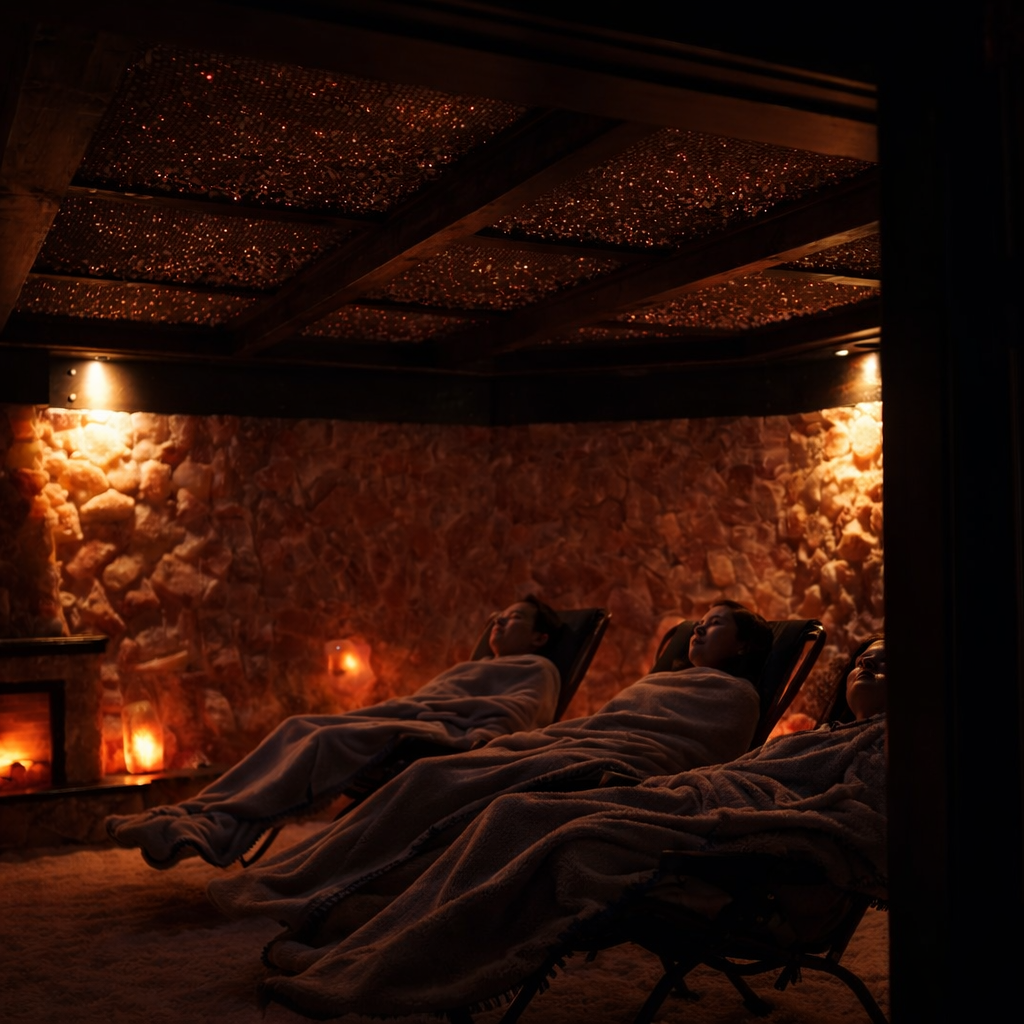
Simply adding a few decorative salt bricks or spreading loose salt around the floor does not create a therapeutic environment. A true salt room requires salt coverage on the walls, controlled airflow, and a properly balanced humidity level.
Without those elements, what people end up with is just a decorative space or, worse, a dusty room that gives the illusion of therapy without delivering the real benefits.
When Good Ideas Ignore Reality
Recently, a new idea has started circulating: mobile salt therapy trailers for horses.
On the surface, it sounds creative. People imagine bringing salt therapy directly to stables or equestrian facilities.
But when someone who truly understands salt therapy hears this concept, the first reaction is usually disbelief.
Why?
Because salt and trailers simply do not mix.
Salt is highly corrosive, especially when combined with moisture. Even if a trailer is made from aluminum, many of its components do not include fasteners, brackets, electrical systems, suspension components, and structural connections.
Salt particles produced during halotherapy are incredibly small. They travel through the air and settle wherever they land. They can penetrate seams, flooring materials, and microscopic gaps.
Even if someone believes they have sealed a trailer perfectly, the reality is that vibration during transportation creates micro-cracks and tiny openings over time. Salt will find those openings.
Once inside the structure, it begins doing what salt naturally does, attracting moisture and corroding whatever it touches.
Wooden flooring will absorb it. Metal components will begin to rust. Electrical systems can deteriorate. Over time, the trailer's chassis and internal parts become vulnerable.
Even worse, trailers are not designed to maintain 24/7 climate control, which is essential in a salt environment. No one runs air conditioning continuously in a trailer sitting in a field or storage lot. As humidity rises and falls, the salt absorbs moisture, accelerating corrosion.
Eventually, the structure itself begins to fail.
So even if someone manages to recreate something that looks like a salt environment inside a trailer, it simply isn’t durable. The concept is fundamentally flawed from the start.
Salt Therapy Is a Science, Not a Decoration
True halotherapy is based on decades of research and practical experience. It requires more than salt blocks on the wall or loose salt on the floor.
A properly functioning salt therapy room includes:
• A
professional salt generator calibrated for particle size and concentration
•
Controlled airflow and distribution of microscopic salt particles
•
Climate control operates continuously to manage humidity and protect the space
•
Salt surfaces on multiple walls, not just a few decorative bricks
• Materials designed specifically to withstand a salt environment
Without these elements working together, the space will not perform as intended.
What people often create instead is either a decorative room or a dusty environment that gives the appearance of therapy without the science behind it.
Protect Yourself From Expensive Mistakes
As salt therapy continues to grow in popularity, more DIY ideas and quick business concepts will appear. Some may sound exciting or innovative at first, but without a deep understanding of halotherapy and environmental design, they can quickly turn into expensive failures.
Building a real salt room is not a simple construction project.
It is a specialized environment that requires knowledge, experience, and proper engineering.
If you’re thinking about adding salt therapy to a wellness center, spa, home, or equestrian facility, the best investment you can make is to work with professionals who understand how to design a space that actually works and lasts.
Salt therapy, when done correctly, can be incredibly rewarding for both clients and business owners. Done incorrectly, it can become a costly lesson.
If you’d like to learn more about how authentic salt therapy environments are designed and built, feel free to reach out. A conversation can often save months of frustration and thousands of dollars in mistakes.
Dr. Margaret Smiechowski www.saltcavebuilder.com, saltcavevt@gmail.com, 802-770-3138