Salt Cave Ventilation Codes and Proper HVAC Design
Learn why salt cave ventilation must remain operational during sessions and how proper HVAC design supports code compliance and halotherapy performance.
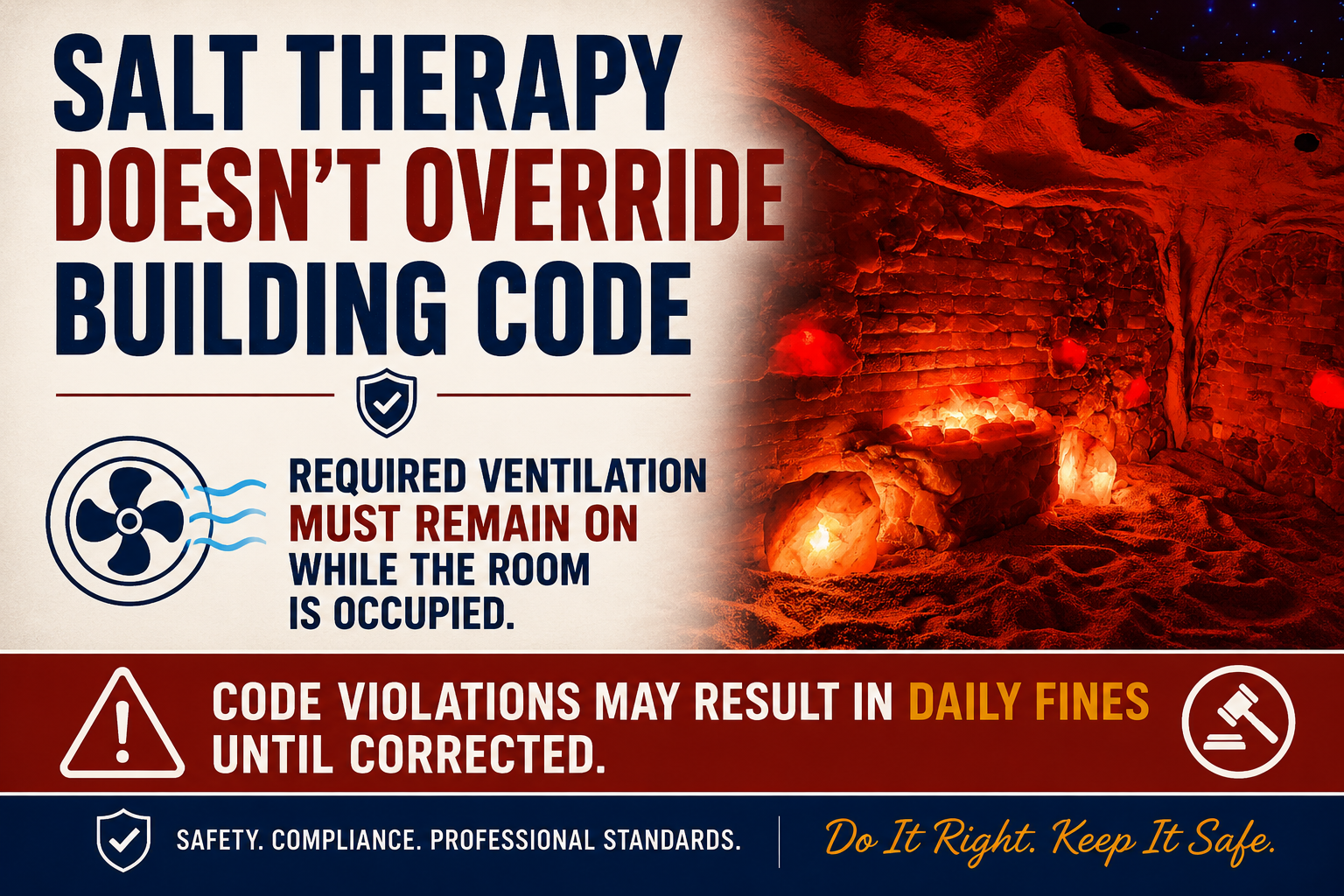
Salt Therapy Does Not Override Building Code: Why Salt Cave Ventilation Must Stay On
Would you turn off the required ventilation while a group of people is breathing in the same room?
This is one of the most important questions in professional salt cave construction. Some overseas salt-room instructions recommend shutting off the HVAC or restricting airflow during a salt therapy session. The reason is usually to keep more dry salt aerosol suspended in the room.
That approach can create a serious problem in the United States. A salt cave does not stop being an occupied indoor space when a halogenerator is running. Required ventilation must remain operational while people are inside unless another approved system continues to provide the required airflow.
Salt therapy does not override building code.
The correct solution is not to choose between effective halotherapy and proper ventilation. A professionally designed salt cave must provide both. The airflow, outdoor-air supply, exhaust, room pressure, climate control and halogenerator output must be calculated to work together.
A Salt Cave Is Still an Occupied Room
Salt rooms may be marketed as relaxation rooms, meditation spaces, wellness rooms or halotherapy environments. Those names do not remove the room from building and mechanical code requirements.
When clients enter the room, the space is occupied. It must receive the ventilation required by the mechanical code adopted in that state or local jurisdiction and by the approved construction documents for the project.
This requirement is not limited to large auditoriums. It can also apply to:
- Commercial salt caves
- Salt therapy rooms
- Conference rooms
- Yoga studios
- Meditation rooms
- Wellness event spaces
- Other rooms where groups of people gather
The exact occupancy classification may vary, but the need for code-compliant ventilation remains.
What the International Mechanical Code Says About Ventilation
The International Mechanical Code, commonly called the IMC, is the primary national model mechanical code used throughout much of the United States. According to the International Code Council, the IMC is used or adopted in 46 states, the District of Columbia and several U.S. territories.
States and municipalities may adopt different editions or add local amendments. Every commercial salt cave project must therefore be checked against the exact code in effect at its location.
Several provisions in Chapter 4 of the 2024 International Mechanical Code are particularly important for salt cave ventilation.
IMC Section 401.2: Every Occupied Space Must Be Ventilated
IMC Section 401.2 requires occupied spaces to be ventilated through code-compliant natural ventilation under Section 402 or mechanical ventilation under Section 403.
Most commercial salt caves are enclosed rooms. They generally do not have operable exterior windows or openings that are sized and approved to provide natural ventilation. As a result, most salt caves depend on mechanical ventilation.
If the required mechanical ventilation is turned off while clients are inside, the room may be left without either ventilation method required by Section 401.2.
IMC Section 403.1: Supply Air Needs a Return or Exhaust Path
IMC Section 403.1 requires mechanical ventilation to include supply air and return or exhaust air. The amount of supply air should be approximately equal to the amount of return and exhaust air. Properly designed positive or negative pressure is permitted.
This matters greatly in salt room HVAC design. Air cannot simply be pushed into a room without determining where it will go. Air also should not be exhausted without an engineered source of replacement air.
Supply air, return air, exhaust, and room pressure must be designed as parts of one complete mechanical system.
IMC Sections 403.2 and 403.3: Outdoor Airflow Must Be Calculated
IMC Section 403.2 requires minimum outdoor airflow to be determined under Section 403.3. A generic instruction manual cannot calculate that requirement for every salt room.
The calculation depends on factors that include:
- The approved use and occupancy classification
- The expected number of occupants
- The room’s floor area
- The activity taking place inside
- The air-distribution design
- How effectively outdoor air reaches the breathing zone
The ventilation-rate procedure includes a people component and a building-area component. The required outdoor airflow is then adjusted according to how air is distributed through the occupied space.
This is one reason no two commercial salt caves should automatically use the same airflow design.
The code permits a registered design professional to propose certain engineered alternatives. However, an alternative requires documented engineering analysis and approval. A business owner, equipment seller or foreign instruction manual cannot simply eliminate required outdoor air because lower airflow might keep more salt aerosol suspended in the room.
IMC Section 405.1: Required Ventilation Must Operate During Occupancy
IMC Section 405.1 provides the clearest direction. Mechanical ventilation systems must have manual or automatic controls that operate the systems whenever the spaces are occupied.
When an air-conditioning system supplies the required ventilation air, its controls must automatically maintain the required outdoor-air supply rate during occupancy.
That means a salt cave cannot be designed around routinely turning off required ventilation whenever a session begins. The required ventilation must continue operating throughout the occupied session.
The same requirement appears in state mechanical codes derived from the IMC. For example, Section 405.1 of the 2025 Mechanical Code of New York State requires mechanical ventilation to operate whenever the served spaces are occupied and requires the necessary outdoor-air rate to be maintained during occupancy.
Is a Salt Cave Always Classified as an Assembly Occupancy?
Not necessarily.
IBC Section 303.1 describes Group A Assembly uses as spaces where people gather for civic, social, religious or recreational activities, food or drink, waiting for transportation and similar purposes.
A salt cave offering group sessions or events may involve an assembly use. However, its final occupancy classification depends on the room’s size, primary use and approved occupancy.
IBC Section 303.1.2 allows certain small assembly spaces that are accessory to another occupancy to be classified as Group B or as part of the other occupancy. This may apply when the occupant load is fewer than 50 people or the accessory space is smaller than 750 square feet.
That classification does not create an exemption from ventilation. The IMC applies to every occupied space. Even a small salt cave classified as Group B must have code-compliant ventilation while people are inside.
The accurate statement is:
Salt caves, salt rooms, and assembly-use rooms must maintain their code-required ventilation while occupied, whether the building official classifies the room as Group A or Group B.
Air-Conditioning, Recirculation and Ventilation Are Different
These terms are often used as though they mean the same thing. They do not.
- Heating and cooling control the temperature.
- Recirculation moves existing indoor air through the room.
- Ventilation introduces the required outdoor air.
- Return or exhaust air gives air a path to leave or transfer from the room.
Turning off cooling equipment would not necessarily violate the ventilation code if a separate mechanical system continues to supply the required outdoor air. However, leaving a fan running does not prove compliance if that fan only recirculates the same indoor air.
The correct question is not simply, “Is the HVAC unit on?”
The correct question is, “Does the approved amount of outdoor ventilation air reach the occupied breathing zone throughout the session, and is the required return or exhaust path operating?”
A Halogenerator Is Not a Ventilation System
A professional halogenerator is essential for active dry salt therapy, but it does not replace a properly designed ventilation system.
The halogenerator grinds and disperses dry salt particles. Its small fan distributes the aerosol; it does not provide the calculated outdoor air, return airflow, exhaust capacity, or pressure control required for a commercial salt cave.
This distinction is important. Installing a halogenerator does not automatically make a room compliant, therapeutic or properly engineered. The equipment must be selected, calibrated and operated for the individual room.
Successful halotherapy requires the halogenerator and the mechanical system to work together.
Why Overseas Salt-Room Instructions May Not Work in the United States
Imported instructions may describe practices developed for a different climate, building type or legal system. They do not replace U.S. state and local codes.
IBC Section 102.4.1 establishes that the code governs when its provisions conflict with referenced codes or standards. A foreign operating manual cannot change the locally adopted mechanical code or the mechanical plans approved for a specific building.
Turning off required ventilation simply to keep more salt aerosol in the room is not an acceptable design solution.
The proper approach is to calculate the ventilation and salt concentration together. This includes:
- Halogenerator output
- Required outdoor air
- Supply airflow
- Return or exhaust airflow
- Room pressure
- Temperature
- Humidity
- Aerosol distribution and removal
Required ventilation should not be sacrificed to make the salt aerosol appear stronger.
Every Commercial Salt Cave Needs Its Own Airflow Design
A commercial salt cave is not simply a sealed decorative room. It is an occupied environment where a halogenerator intentionally introduces dry salt aerosol.
If the airflow is excessive or placed incorrectly, the aerosol may leave the room too quickly. If the required ventilation is eliminated, the room may violate code.
The answer is not generic airflow. It is also not zero airflow. The answer is a calculated, balanced system designed for that specific salt cave.
The design must consider:
- Room dimensions
- Expected occupant load
- Session length
- Supply and return locations
- Outdoor-air requirements
- Exhaust path
- Room pressure
- Door movement
- Filtration
- Halogenerator output
- Temperature and humidity
- Local climate
This work should be coordinated with a licensed mechanical professional and submitted to the authority having jurisdiction when required.
Possible Fines and Other Code-Enforcement Consequences
There is no single national fine for turning off required ventilation. Model codes become enforceable after they are adopted by a state or municipality. Penalties are then determined by state laws and local ordinances.
The amount can depend on whether the owner received notice, whether the condition was corrected, whether it is a repeat violation, who is responsible, and whether the violation threatens health or safety.
Examples of authorized penalties include:
State Examples of possible penalties. Massachusetts: Massachusetts General Laws, Chapter 143, Section 94 authorizes a fine of up to $1,000, imprisonment for up to one year, or both, for each state building-code violation. Each day the violation exists can be a separate offense. New York: New York Executive Law Section 382 allows fines of up to $1,000 per day, imprisonment for up to one year, or both, when a person fails to comply with an order or knowingly violates applicable Uniform Code provisions.Florida: Florida Statutes Section 162.09 generally permits up to $250 per day for a first violation, $500 per day for a repeat violation, and up to $5,000 for an irreparable or irreversible violation. Qualifying larger jurisdictions may adopt higher limits. Pennsylvania: Pennsylvania’s Uniform Construction Code statute, Section 7210.903 provides for a fine of up to $1,000 plus costs. Each day a violation continues may be treated as a separate violation. Virginia: Virginia Code Section 36-106 makes violation of the Uniform Statewide Building Code unlawful. A conviction can carry a fine of up to $2,500, with higher ranges possible for repeat convictions.
These are statutory maximums or authorized penalty ranges. They are not automatic fines in every situation.
Code enforcement may also involve:
- Notices of violation
- Orders to correct the system
- Permit problems
- Restrictions on occupancy
- Court-ordered abatement
- Liens
For example, Florida Statutes Section 553.79 allows an enforcing agency to revoke a permit when work does not conform to the Florida Building Code.
The actual penalty for a particular salt room depends on the applicable state law, locally adopted mechanical code, municipal ordinances, approved plans and facts of the violation. A local building official, licensed mechanical engineer or attorney should be consulted for a project-specific determination.
Build the Salt Cave Correctly From the Beginning
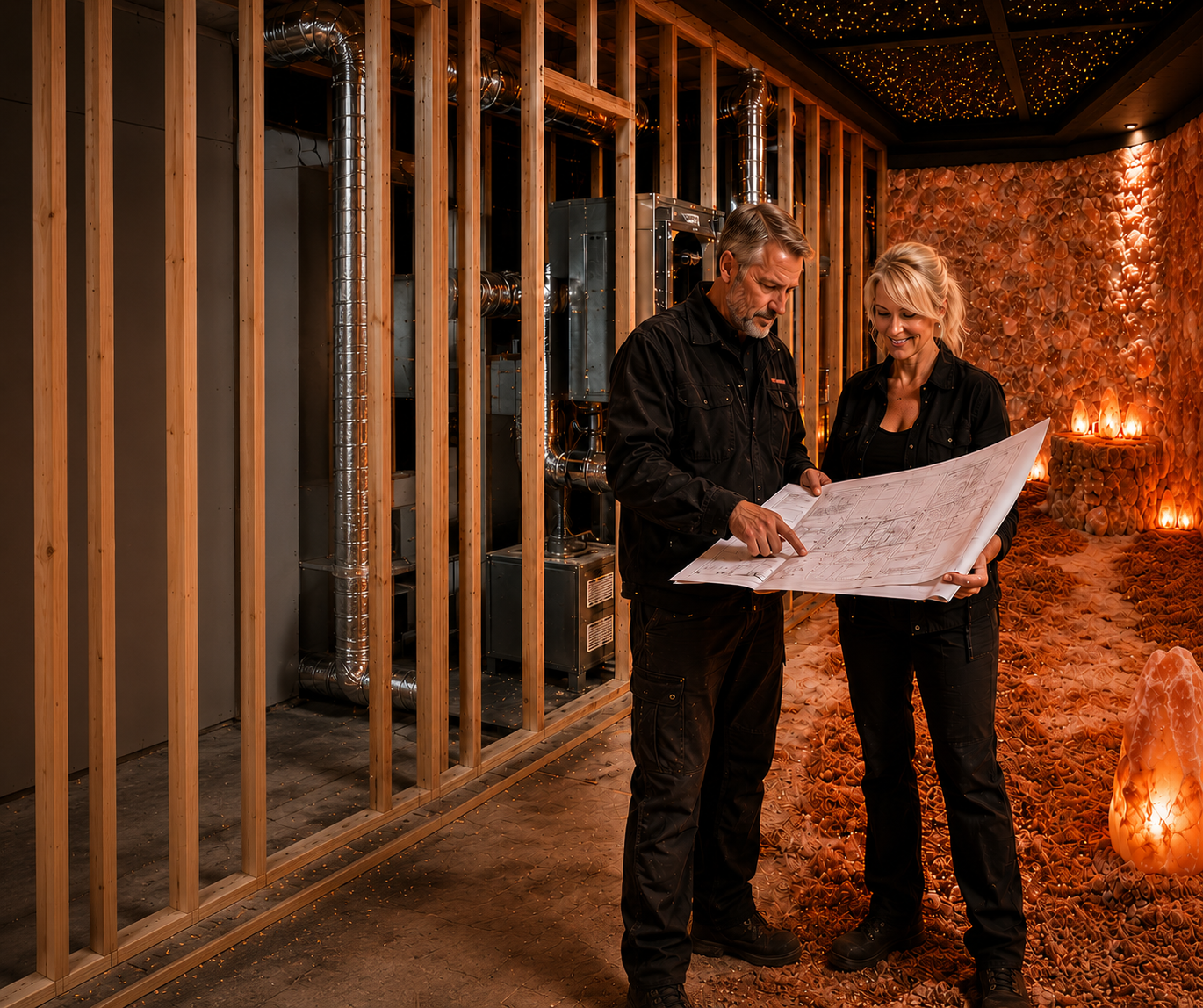
Professional salt cave construction requires much more than installing salt walls and purchasing a halogenerator. It requires a complete environment where ventilation, climate control,
and salt delivery work together.
Salt Cave Builder has designed and constructed professional salt caves throughout the United States for more than two decades.
Every cave receives an individual design because every room, building, climate, and business is different.
Before following instructions that recommend shutting off ventilation during a session, determine exactly how the required outdoor air will be maintained.
Make sure the complete design complies with the building and mechanical codes adopted by the local jurisdiction.
Do it correctly from the beginning.
To discuss professional salt cave design and nationwide salt cave construction, call Salt Cave Builder. at 802-770-3138, email saltcavevt@gmail.com, or visit SaltCaveBuilder.com.