Salt Cave Construction: Brine Towers vs. Halogenerators
Learn why brine-gradient towers and dry-salt halogenerators need different climate control in professional salt cave and salt room construction.
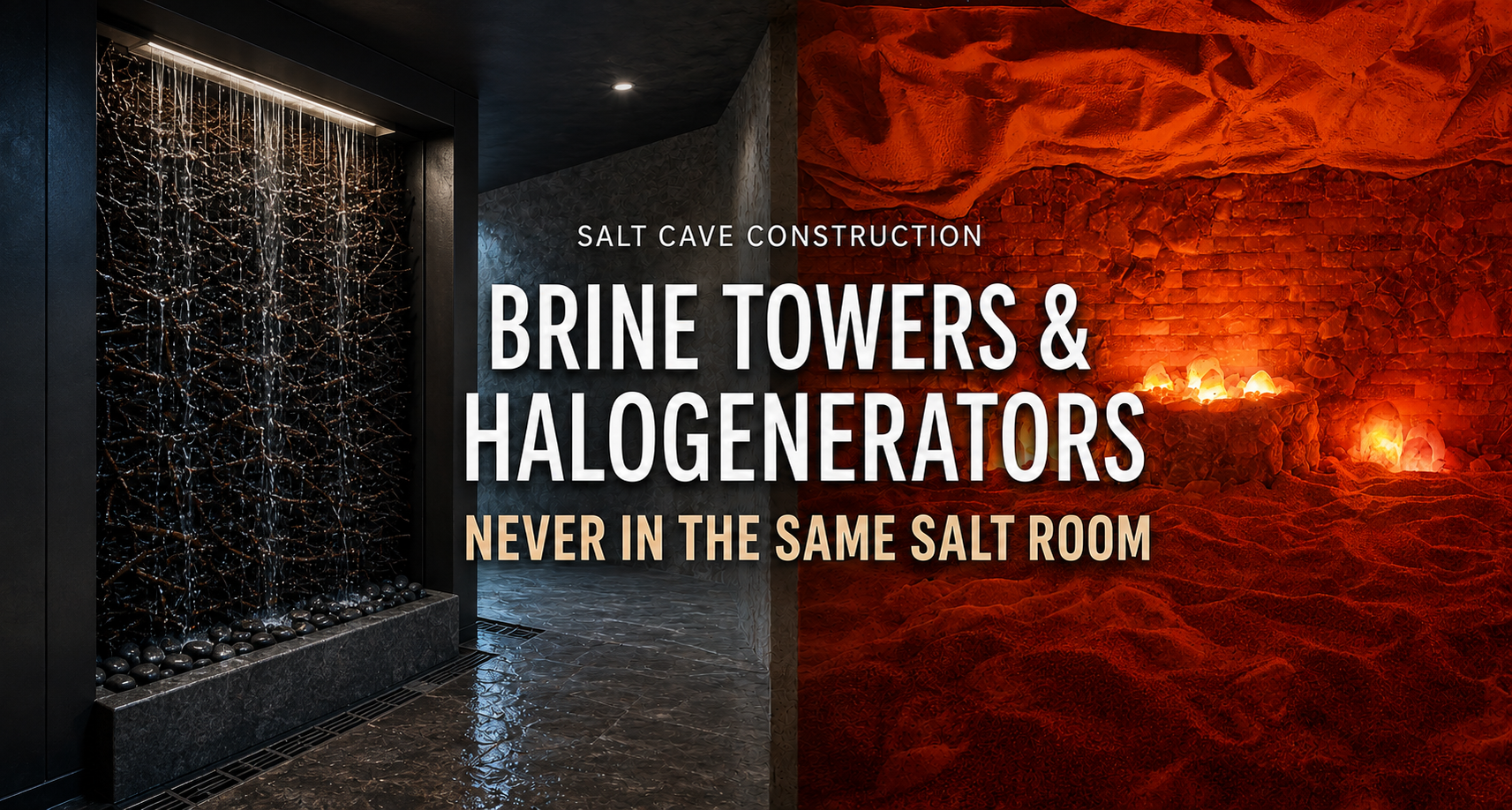
Salt Cave Construction: Why Brine Graduation Towers and Halogenerators Must Never Be Combined
When planning a commercial salt cave or salt room, one of the most important decisions is how salt will be introduced into the environment. Its origin, purity, and intended use matter, but the delivery system matters just as much.
A brine graduation tower and a dry-salt halogenerator both involve salt, yet they create completely different indoor environments.
This distinction is frequently misunderstood during salt cave construction.
A brine graduation tower produces a moist saline environment by circulating liquid brine. A halogenerator grinds dry salt into microscopic particles and disperses them into the air. One introduces moisture; the other depends on carefully controlled dry conditions.
Placing both systems in the same salt therapy room can cause them to work against each other and prevent either from performing as intended.
Professional salt room construction requires far more than attaching Himalayan salt to the walls and purchasing equipment. Salt coverage, airflow, ventilation, humidity, temperature, materials and maintenance procedures must be coordinated from the beginning.
Why the Source and Form of Salt Matter
Decorative Himalayan salt boulders, bricks, loose floor salt, brine, and halogenerator salt all perform different functions.
Walls and floors create the cave’s salt-rich interior. Brine-tower salt is dissolved in water, whereas halogenerator salt must meet equipment specifications for grinding into controlled-dry particles.
Before construction begins, the builder should know:
- Where the salt comes from
- Its purity, mineral content and consistency
- Whether it will be used decoratively, structurally, in brine or for aerosol generation
- How it will respond to humidity and temperature changes
- Whether it is compatible with the selected equipment
- How it must be stored, handled and maintained
Choosing salt only by color or price can be an expensive mistake. Excessive clay, contaminants, or inconsistent mineral deposits may make salt unsuitable for certain applications. The source must be selected for its intended purpose, not simply its appearance.
What Is a Brine Graduation Tower?
A brine graduation tower continuously circulates saline water over a structure.
Traditional European towers are large outdoor wooden frames filled with bundles of blackthorn branches. Brine trickles downward; as water partially evaporates, the brine becomes more concentrated and a moist saline aerosol develops around the tower.
Research on traditional Polish graduation towers describes outdoor evaporation systems in which brine flows over brushwood, separates into droplets, and partially evaporates under favorable sun, temperature, and wind conditions. Researchers also identified changing bacterial and archaeal communities within the circulating brine. This does not prove that every indoor tower will become contaminated, but it demonstrates that brine systems are active water environments requiring serious maintenance. Research on microbial communities in brine graduation towers
Indoors, the same technology functions as a circulating water feature, releasing moisture into an enclosed space.
An Indoor Brine Tower Must Be Treated as a Water Feature
Any indoor water feature can create problems when moisture is not controlled. A brine graduation tower can increase humidity, cause splashing and leaking, and create condensation on colder surfaces. Moisture may migrate into drywall, ceiling cavities, insulation, flooring and ductwork.
A brine tower must therefore be incorporated into the building’s mechanical and moisture-management design.
The U.S. Environmental Protection Agency explains that indoor mold growth is controlled primarily by controlling moisture. The EPA recommends keeping indoor relative humidity below 60 percent, ideally between 30 and 50 percent where possible. It also recommends addressing condensation and drying wet areas promptly. EPA guidance on mold and indoor moisture
These principles are especially important in commercial salt cave construction because the room contains both moisture and corrosive salt. A neglected brine feature may contribute to material deterioration, corrosion, unpleasant odors, and conditions that allow mold to develop on compatible organic surfaces.
Salt does not automatically make a water system sanitary. Some microorganisms tolerate saline environments. Brine concentration, water quality, temperature, circulation, and cleaning all influence system performance.
Brine Graduation Towers Require Specialized Climate Control
A properly designed indoor brine tower needs climate control calculated for the room. The builder and mechanical professionals must evaluate square footage, ceiling height, water volume, evaporation, occupancy, local climate, ventilation, and surface temperatures.
Depending on the design, the room may require:
- Dedicated humidity control and dehumidification
- Continuous temperature and relative-humidity monitoring
- Properly calculated supply and exhaust airflow
- Condensation protection for cold surfaces and ductwork
- Drainage, overflow and leak protection
- Water-resistant and salt-compatible construction materials
- Accessible pumps, reservoirs and piping for inspection
- A cleaning, water-treatment and maintenance plan
A standard residential air conditioner or commercial HVAC unit may not remove enough moisture. Oversized equipment can cool the room quickly and shut off before adequate dehumidification occurs. Design must be based on the actual moisture load.
Ventilation must comply with applicable codes. Because a salt therapy room is occupied, required outdoor air cannot simply be shut off to preserve salt concentration. Airflow must maintain both compliance and the intended environment.
What Is a Halogenerator?
A halogenerator grinds dry salt into very small particles and introduces a measured aerosol into the room. It is not a humidifier or brine nebulizer.
The halogenerator must be selected, positioned, ducted and calibrated for the specific room. Settings depend on room volume, occupancy, session length, airflow, ventilation, salt coverage and the equipment’s output.
The climate-control system must support the dry aerosol. If the room is too humid, dry salt particles can absorb water from the air. Sodium chloride is hygroscopic, meaning its particle size and physical behavior change as humidity rises. Laboratory research demonstrates that sodium chloride aerosols take up water and grow under humid conditions. Research on the hygroscopic growth of saline aerosols
As particles absorb moisture, they may grow, join together, and settle more quickly. That reduces suspension time and changes dry-salt distribution in the breathing zone.
The halogenerator, ventilation and room climate must work together.
Why a Brine Tower and Halogenerator Work Against Each Other
The conflict is straightforward:
- A brine-gradient tower circulates saltwater and produces moisture.
- A dry-salt halogenerator requires controlled conditions that support a dry aerosol.
- Salt particles naturally interact with water vapor.
- Added humidity changes particle size, suspension, and settling behavior.
When both systems operate in one room, moisture can interfere with the dry aerosol. The halogenerator may continue releasing salt, but more salt cannot correct an incompatible environment.
Increasing the generator setting may create more residue without solving the problem. The real issue is the conflict between wet and dry delivery technologies.
Do not combine a brine-graduation tower with a dry-salt halogenerator in a single treatment room. Businesses offering both should use separate spaces, each with its own environmental calculations, equipment, and maintenance procedures.
Daily Care Is Essential for Every Brine System
Daily brine-tower inspection and maintenance should be planned before the business opens.
Operators should monitor:
- Brine concentration and visible water quality
- Pumps, reservoirs, filters and circulation lines
- Branches, media and all wetted surfaces
- Drains, overflow protection and surrounding floors
- Room temperature and relative humidity
- Condensation on walls
- Unusual odors, discoloration, slime or mineral buildup
- Leaks and moisture around hidden connections
Maintenance must follow manufacturer requirements and applicable public health or building codes. Staff should know who performs each task and what conditions require professional inspection.
Maintenance access is a construction issue. Pumps, filters, tanks, drains and concealed connections must be reachable without damaging the finished cave. Components hidden behind permanent salt walls make routine care difficult and costly.
Construction Materials Must Match the Environment
Salt can accelerate corrosion and damage incompatible metals, fasteners, electrical components, HVAC parts, adhesives and finishes. A room containing both salt and water is especially demanding.
Professional salt room construction should evaluate every exposed or concealed material, including:
- Wall and ceiling assemblies
- Waterproofing and vapor-management layers
- Fasteners, framing and structural supports
- Adhesives, coatings, sealants and grout
- Electrical boxes, wiring pathways and lighting
- HVAC diffusers, returns, ducts and controls
- Pumps, piping, drains and filtration equipment
- Furniture, fabrics and decorative materials
Branches and untreated organic decorations can collect salt, dust and moisture and may be difficult to clean. Natural-looking materials are not always appropriate for an enclosed commercial environment.
The goal is a beautiful, durable, cleanable space that continues to perform for years.
Common Salt Room Construction Mistakes
Many long-term problems begin with decisions made before construction starts. Common mistakes include:
- Selecting equipment before calculating the room’s airflow and moisture loads.
- Treating a brine graduation tower as decoration instead of a water system.
- Installing a brine tower and dry-salt halogenerator in the same room.
- Assuming saltwater cannot support microbial activity.
- Relying on standard HVAC equipment without specific humidity calculations.
- Using materials that corrode, absorb moisture, or cannot be cleaned.
- Hiding pumps, drains and filters behind finished walls without service access.
- Ignoring daily operating and maintenance requirements.
- Turning off required ventilation during occupied sessions.
- Hiring a builder who understands decoration but not salt aerosol, moisture and mechanical systems.
Correcting these mistakes after the cave is finished can require opening walls, replacing equipment, rebuilding decorative features, and redesigning the ventilation system. Proper planning protects the initial investment and can prevent expensive reconstruction.
How the Builder Can Affect the Success of Your Business
A salt cave can be visually impressive yet technically unsuccessful. Clients may not understand the engineering, but they notice the results. They notice musty odors, excessive humidity, visible residue, condensation, uncomfortable temperatures, and inconsistent experiences.
Those problems can lead to disappointed clients, poor reviews, fewer repeat visits, higher maintenance costs and business interruptions.
An experienced salt cave builder considers the entire operation. The design should support staff training, cleaning, equipment service, durability and a consistent client experience.
Before hiring a builder, ask:
- How many commercial salt caves and salt rooms have you completed?
- Have you designed both wet-brine and dry-salt environments?
- How will humidity, ventilation and condensation be calculated?
- What type and source of salt will be used for each application?
- Are you recommending both a brine tower and halogenerator in one room?
- Which materials will be protected from salt and moisture?
- How will mechanical equipment be accessed for maintenance?
- Who will calibrate the halogenerator and climate-control system?
- What training and long-term support will be provided after opening?
- Can I speak with owners of operating facilities you have built?
The builder you choose can help position your salt cave business for long-term success—or leave you with an attractive room that does not perform as expected.
Professional Salt Cave Construction Requires Experience
Salt Cave Builder has designed and built commercial and residential salt caves throughout the United States for more than two decades. Dr. Margaret Smiechowski pioneered the simulated salt cave concept in the United States and spent years developing systems that coordinate salt coverage, climate control, and dry-salt generation.
We understand salt cave construction as builders and as owners of a working salt cave facility. That provides direct knowledge of maintenance, client expectations, wellness trends and the decisions that affect profitability.
Every room is different. Its size, use, occupancy, climate, ventilation, materials and design must be evaluated individually. There is no universal kit or single equipment setting that works for every project.
If you are considering commercial salt cave construction, salt room construction, a brine graduation tower, or a halogenerator, involve an experienced builder at the beginning of the project. Early coordination with the architect, general contractor, and mechanical professionals can prevent expensive corrections and protect your investment.
To discuss your salt cave or halotherapy room, call Salt Cave Builder. at (802) 770-3138 or visit www.saltcavebuilder.com.